Best Cast Iron Stock Pot by Capacity and Weight
Seven pots, three metals, and one figure that settles the argument: how many quarts you can actually lift when the pot is full. Here's how the capacities and weights line up, and which pot suits which kind of cooking.
The best cast iron stock pot for professional chefs is, on the published numbers, not cast iron at all: the P&P CHEF 12 Quart Stock Pot gives you 12 quarts of working volume at 4.89 lb, roughly a third the weight of the 7QT enameled cast iron pot in this group. If you want the heat retention that only iron gives you, the Umite Chef 7QT Enameled Cast Iron Dutch Oven is the pick, and it weighs 15.6 lb empty. Capacity per pound is what splits this field, and almost nobody compares it.
Best cast iron stock pot for professional chefs at a glance
| Pick | Capacity | Empty weight | Price |
|---|---|---|---|
| Best overall P&P CHEF 12 Quart Stock Pot with Lid |
12 qt | 4.89 lb | Check Price |
| Best upgrade Umite Chef 7QT Enameled Cast Iron Dutch Oven |
7 qt | 15.6 lb | Check Price |
| Best for pros HOMICHEF Large Stock Pot 24 Quart With Lid |
24 qt | 8 lb | Check Price |
| Best premium HexClad 12QT Hybrid Nonstick Braiser Stock Pot |
12 qt | 6.3 lb | Check Price |
| Best minimal setup Umite Chef 6QT Enameled Cast Iron Dutch Oven |
6 qt | 14.3 lb | Check Price |
| Best budget pick P&P CHEF 6 Quart Stainless Steel Stock Pot |
6 qt | 4.14 lb | Check Price |
| Runner-up Commercial Chef 3.4-Qt. Dutch Oven with Lid |
3.4 qt | 7.73 lb | Check Price |
How I screened these seven pots down
I lined up every listing in this set by the numbers that appear on the page, not by the marketing headline above them. Three figures did the sorting: published capacity, published empty weight, and published base construction.
That immediately reshuffled the field. Capacity ranges from 3.4 quarts to 24 quarts here, a seven-fold spread. Empty weight runs from 4.14 lb to 15.6 lb, and the two figures barely correlate. The heaviest pot in the group holds 7 quarts. The lightest holds 6.
- Four of the seven publish a tri-ply or 3-ply base in their feature copy.
- Three are enameled or bare cast iron: the two Umite Chef Dutch ovens and the Commercial Chef 3.4-quart.
- Only one publishes a warranty of any kind. HexClad states a lifetime warranty against manufacturing defects, and explicitly excludes commercial and restaurant use.
- Only one arrives with a stated accessory bundle beyond a lid.
That last point matters for a search about a cast iron stock pot for professional chefs. The one pot here that names a warranty in writing also names restaurants as the place where the warranty stops. Read that as the category telling you something.
Which cast iron stock pot capacity do you actually need?
Capacity is the specification that decides this purchase, and most guides bury it under talk of heat retention. Stock needs headroom. A 6-quart pot filled with bones and mirepoix gives you maybe four quarts of finished liquid after reduction, which is a home batch, not a service batch.
Here is how the published capacities in this set map to actual jobs:
- 3.4 quarts. Side dishes, a small braise, one loaf of bread. The Commercial Chef sits here.
- 6 to 7 quarts. Four to six servings. Both Umite Chef pots and the P&P CHEF 6 Quart cover this band. Umite Chef states 6 to 8 servings for the 7QT.
- 12 quarts. Real stock territory, plus pasta water for a crowd. Two pots share this figure: the P&P CHEF 12 Quart and the HexClad 12QT.
- 24 quarts. Batch work, stock you freeze, canning. Only the HOMICHEF reaches it.
Note what happens to weight as you climb. The 12-quart P&P CHEF weighs 4.89 lb and the 24-quart HOMICHEF weighs 8 lb, while the 7-quart enameled cast iron pot weighs 15.6 lb. Iron gives you thermal mass. It charges you for that in the wrist.
Cast iron or stainless: which does the stock pot job better?
Cast iron and stainless steel are not interchangeable, and the search that brought you here mixes them. A cast iron stock pot is really a Dutch oven: thick walls, a heavy lid, slow to heat and slow to let go. Stainless with an aluminum core is quick to respond and much lighter to move full.
For stock specifically, the case for iron is weaker than its reputation suggests. Stock simmers for hours at a steady low temperature. You do not need a vessel that holds heat through a temperature swing, because there is no swing. You need volume, a base that resists scorching, and handles you can trust when the pot is heavy.
That is why the two 12-quart pots and the 24-quart HOMICHEF outrank the iron pots for stock work here. All three publish a multi-ply base. HOMICHEF states a 4.2 mm thick 3-ply base with a pure aluminum core.
Where iron wins outright is browning then braising in one vessel, and baking bread with the lid on. Both Umite Chef pots are built for that. So keep the question narrow: are you making liquid, or are you making a braise?
1. P&P CHEF 12 Quart Stock Pot with Lid — Best overall
Twelve quarts at 4.89 lb is the best capacity-to-weight ratio in this group, which is the number that matters when the pot is full.

Best for: long stock and pasta batches on a home range Skip it if: you need a pot that holds oven heat for hours
Set this against the enameled cast iron pots and the difference is stark. You get nearly double the volume of the 7QT Umite Chef at less than a third of the empty weight. A full 12-quart pot of stock is heavy enough on its own without adding 10 lb of vessel to it.
P&P CHEF states 18/10 stainless steel construction with a tri-ply bottom, and says the 3-ply base prevents food burning on the bottom. The pot measures 8.8 x 10 x 10 in, so the 10 in diameter sits comfortably on a standard large burner rather than spanning two. Model number is SSSP-20. The lid is tempered glass with a steam vent, which lets you watch a reduction without breaking the simmer, and the brand says the two riveted handles are thickened for load.
The compromise is thermal mass. This pot heats fast and cools fast, so it is poor at holding a braise at temperature through an oven cycle, and there is no published warranty. Only one seller lists it, which limits your options if something arrives dented.
Pros:
- 12 qt capacity at only 4.89 lb empty
- Tri-ply base claimed to stop bottom scorching
- 10 in diameter fits one large burner
- Vented tempered glass lid for monitoring reductions
- 18/10 stainless steel stated by the brand
Cons:
- No published warranty
- Thin walls hold far less heat than iron
- Only one seller lists it
- Glass lid is less oven-friendly than a cast iron lid
2. Umite Chef 7QT Enameled Cast Iron Dutch Oven with Lid — Best upgrade
The heaviest pot here at 15.6 lb, and that mass is exactly the point if you are searing and braising in one vessel.

Best for: braising and no-knead bread at 6 to 8 servings Skip it if: you dislike lifting 15.6 lb before food goes in
This is the pot buyers choose most often out of the seven, and it sells faster than anything else in this set by a wide margin. On the published data, the reason is the combination of 7 quarts, real enameled iron, and a bundle: Umite Chef includes cotton potholders, the only pick here that names a soft accessory in the listing.
Measurements are 7.5 x 13.9 x 13.9 in, so it is wide and shallow rather than tall. That geometry browns better than a stock pot shape because more meat touches the base at once. Umite Chef says the lid is precision-engineered for a tight seal, and describes the enamel glaze as naturally non-stick and resistant to stains. The brand states 6 to 8 servings, which lines up with the 7QT figure.
Against the stock pots here, the losses are volume and handling. Seven quarts is not a stock batch, and 15.6 lb empty is more than three times the P&P CHEF 12 Quart. It is also the most expensive pick in this group without matching the capacity of pots that cost less.
Pros:
- 7 qt of enameled cast iron for genuine heat retention
- Cotton potholders included, unique in this set
- 13.9 in wide base gives real searing area
- Brand states 6 to 8 servings
Cons:
- 15.6 lb empty, heaviest pot in the group
- Most expensive pick here despite modest 7 qt capacity
- Enamel can chip if knocked or thermally shocked
- No published warranty
3. HOMICHEF LARGE STOCK POT 24 Quart With Lid — Best for pros
Twenty-four quarts and a stated 4.2 mm 3-ply base put this closest to the volume a working kitchen actually runs.

Best for: batch cooking, canning and 24-quart stock runs Skip it if: your burner or storage cannot handle a 12 in pot
Nothing else in this group comes close on volume. Twenty-four quarts is double the two 12-quart pots and more than triple the 7QT cast iron. At 8 lb, it is still lighter empty than either enameled Dutch oven, which is the argument for stainless in large formats spelled out in a single figure.
HOMICHEF publishes the base construction in detail: 3-ply with one layer of pure aluminum core between two stainless layers, 4.2 mm thick, which the brand says eliminates warping and hotspots. The body steel is listed as Japanese standard JYH21CT (21/0) and the handles as 430 (18/0), and the brand's headline claim is that the pot is nickel free. If you react to nickel, that spec is the reason to look here first. Model 701A24, with a mirror polished exterior, matte interior and a vented tempered glass lid. The count of 2 covers pot plus lid.
Dimensions are 12.7 x 12 x 12 in, which is a lot of cabinet. It is also among the pricier picks here, and a 21/0 body is less corrosion-resistant than 18/10 steel.
Pros:
- 24 qt, the largest capacity in this set
- 4.2 mm 3-ply base with pure aluminum core
- Nickel free steel stated by the brand
- Only 8 lb empty despite the volume
- Vented tempered glass lid included
Cons:
- 12 in footprint needs serious storage space
- 21/0 body steel is less stain-resistant than 18/10
- No published warranty
- Only one seller lists it
4. HexClad 12QT Hybrid Nonstick Braiser Stock Pot with Lid — Best premium
The only pick here with a published warranty, and the only one built to sear and simmer in the same surface.
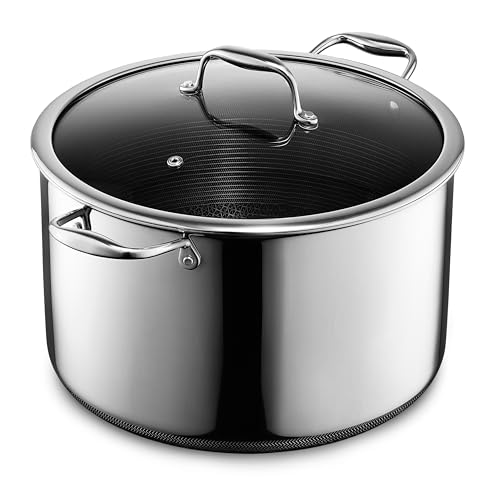
Best for: one-pot cooks who want to sear and simmer in the same vessel Skip it if: the pot is destined for a restaurant line
HexClad matches the 12-quart capacity of the P&P CHEF winner and adds 1.41 lb, coming in at 6.3 lb. What you get for the weight and the price is a different interior. HexClad describes a laser-etched hexagonal pattern that combines stainless steel peaks with a TerraBond ceramic coating, aiming to sear like steel and release like nonstick.
Tri-ply construction with an aluminum core is stated, along with induction compatibility. The listing puts the pot at roughly 11.8 in diameter and 7.5 in height, and overall dimensions are 7.5 x 16.5 x 11.8 in with the handles counted. A tempered glass lid is included.
The warranty is the genuinely distinguishing detail, and it comes with a catch that matters for anyone searching for a cast iron stock pot for professional chefs: HexClad states the lifetime coverage against manufacturing defects excludes commercial and restaurant use. So the strongest paper guarantee in this set is void in exactly the setting the keyword describes.
It is also the most expensive pot here and it holds half the volume of the HOMICHEF. Coated surfaces have a service life that bare iron and plain steel do not.
Pros:
- Lifetime warranty against manufacturing defects, unique here
- 12 qt at 6.3 lb, lighter than either cast iron pot
- Hybrid steel and ceramic interior for searing plus release
- Tri-ply aluminum core, induction ready
Cons:
- Warranty excludes commercial and restaurant use
- Highest price position in this set
- Coating will wear where bare steel would not
- Half the capacity of the 24 qt HOMICHEF
5. Umite Chef 6QT Enameled Cast Iron Dutch Oven with Lid — Best minimal setup
Six quarts of enameled iron plus heat resistant gloves, and it lands in the entry price group.

Best for: a single Dutch oven doing stews, soups and bread Skip it if: you cook stock in 10-quart batches
This is the same recipe as the 7QT above, one quart smaller and 1.3 lb lighter at 14.3 lb, and it sits among the cheaper picks rather than the priciest. If your goal is to own one iron pot and use it for everything, that combination is hard to argue with.
Dimensions are 6.42 x 13.5 x 13.5 in, so the base is nearly as wide as the 7QT despite the smaller volume. Umite Chef states a lead-free, cadmium-free enamel coating, an airtight lid seal, extra-wide stainless steel handles sized to grip with mitts on, and chip-resistant enamel. Heat resistant gloves come in the box, which is the only glove bundle in this set. The brand says it moves from induction stovetop to oven, though the exact oven ceiling is cut off in the listing copy.
Two sellers stock it, giving you a fallback the single-seller picks do not offer. The trade-offs are the ones iron always brings: 14.3 lb empty, and 6 quarts is a family volume, not a stock volume. There is no published warranty either.
Pros:
- Enameled cast iron at an entry price position
- Heat resistant gloves included
- Lead-free and cadmium-free enamel stated
- 13.5 in base gives good browning area
- Two sellers stock it
Cons:
- 14.3 lb empty is heavy for one-hand lifting
- 6 qt is too small for real stock batches
- Oven temperature limit not fully published
- No stated warranty
6. P&P CHEF 6 Quart Stainless Steel Stock Pot — Best budget pick
The lightest pot in this set at 4.14 lb, and the cheapest of the seven.

Best for: four to six servings of soup or pasta Skip it if: you regularly cook for more than six
If a pot is going to live on the stove and get used daily, 4.14 lb changes how often you reach for it. This is the smaller sibling of my top pick, model SSSP-46, at 5.44 x 14 x 9.96 in with the handles included.
The handle treatment is what separates it from the 12-quart version. P&P CHEF says the stainless handles are wrapped in heat-resistant silicone and double-riveted for balance, which is the only silicone handle claim in this group. Everything else here gives you bare steel or iron. The brand also states pure stainless steel construction, a tri-ply bottom with interior and exterior layers, a mirror polished finish inside and out, dishwasher safety, and a vented glass lid. Suggested use is 4 to 6 people.
Six quarts is the constraint you have to accept. It is half the volume of the 12-quart P&P CHEF and a quarter of the HOMICHEF, so stock comes out in small batches. Thin stainless also means you have to watch a long simmer more carefully than you would with iron, and no warranty is published.
Pros:
- Cheapest of the seven picks
- Lightest at 4.14 lb
- Silicone-wrapped handles, unique in this set
- Tri-ply base and dishwasher safe per the brand
- Vented glass lid for tracking progress
Cons:
- 6 qt limits stock to small batches
- Little thermal mass for slow braising
- No published warranty
- Only one seller lists it
7. Commercial Chef 3.4-Qt. Dutch Oven with Lid — Runner-up
Bare cast iron with a dome lid at 3.4 quarts, and the least documented listing in this set.

Best for: small-batch braises and side dishes Skip it if: you want published dimensions before you buy
This is the one true bare cast iron pot in the group, black rather than enameled, model CHCI340. At 3.4 quarts with a dome lid it is the smallest capacity here by a wide margin, and at 7.73 lb it carries more than half the weight of the 14.3 lb Umite Chef 6QT in less than 60% of the volume. That is dense iron for its size, which is what makes a small pot hold temperature during a two-hour braise.
The dome lid is worth noting. A domed profile gives condensation more surface to run back down into the pot, which suits a covered braise. Two sellers list it, so you have a second source.
Documentation is the problem. The listing carries a single feature line describing it as a must-have for novices and experts alike, and the published dimensions read 0 x 0 x 0 in, which tells you nothing about diameter or whether it fits your burner or oven rack. Bare iron also needs seasoning and careful drying, unlike the enameled pots here. It ranks as the slowest seller of the seven, and it is the smallest pot in a roundup where capacity is the deciding number, so it earns its place only for small-format cooking.
Pros:
- Bare cast iron, the only one in this set
- Dome lid returns condensation to the food
- Dense 7.73 lb build for its 3.4 qt size
- Two sellers stock it
Cons:
- 3.4 qt is far too small for stock
- Dimensions published as 0 x 0 x 0 in
- Single feature bullet, minimal published detail
- Bare iron needs seasoning and hand drying
- Slowest seller of the seven
What the listings do not tell you about lids and handles
Two components fail long before a pot body does, and the listing copy is thin on both.
Lids. Four picks here specify tempered glass with a steam vent: both P&P CHEF pots, the HexClad and the HOMICHEF. Glass lets you watch a reduction without lifting, and the vent stops pressure building. It is also the part most likely to break, and no listing in this set states a replacement path. The cast iron and enameled pots use matching heavy lids instead, which seal better and go into a hot oven without a second thought.
Handles. Only the P&P CHEF 6 Quart claims silicone wrapping. Everything else is bare metal, so a full 24-quart HOMICHEF or a 15.6 lb Umite Chef means two thick towels or the included gloves. Umite Chef says its 6QT handles are extra-wide specifically so mitts fit, which is a small design note that pays off every time.
What none of them publish is the oven temperature ceiling as a number, or the gauge of the pot wall above the base. Base thickness gets quoted; wall thickness never does. That is the gap between a listing and a spec sheet.
When a different pick wins
The winner is right for most people, and here are the thresholds where it stops being right.
- You cook more than 12 quarts of stock at a time. Go to the HOMICHEF 24 Quart. There is no substitute for volume, and at 8 lb it stays manageable.
- You brown then braise in the same pot. Go to the Umite Chef 7QT. Its 13.9 in base and 15.6 lb of iron do a job thin stainless cannot.
- Storage is genuinely tight. The HOMICHEF's 12.7 x 12 x 12 in footprint is the one to avoid. The P&P CHEF 6 Quart at 5.44 x 14 x 9.96 in is the smallest to store.
- You want a written warranty. Only HexClad publishes one, and only for non-commercial use.
- You have a nickel sensitivity. HOMICHEF is the only pick that states nickel free steel.
- You cook for two. The Commercial Chef 3.4-quart is the only pot here sized for that.
On the keyword itself, be straight with yourself: no pot in this group is documented as commercial-rated equipment. One explicitly excludes restaurant use from its warranty. Treat "professional" as a description of build quality you have to judge from the base thickness and material, not as a certification anyone here is offering.
The verdict
At the entry end, the P&P CHEF 6 Quart is the pick. It is the cheapest and lightest here at 4.14 lb, it has the only silicone-wrapped handles in the set, and 6 quarts covers 4 to 6 servings without demanding cabinet space. The Umite Chef 6QT sits at a similar price position and offers real enameled iron plus gloves instead, if thermal mass matters more to you than weight.
In the middle, the P&P CHEF 12 Quart takes the overall win. Twelve quarts at 4.89 lb with a tri-ply base and a vented glass lid is the most usable combination in this group for anyone actually reducing stock, and a 10 in diameter keeps it on one burner.
At the premium end you choose between two philosophies. The HOMICHEF 24 Quart buys volume and a documented 4.2 mm 3-ply nickel free base. The HexClad 12QT buys a hybrid searing surface and the only published warranty here, with commercial use carved out. The Umite Chef 7QT is the premium iron option and the one buyers pick most often, at the cost of 15.6 lb empty.
The cutoff is 12 quarts. Below it, buy for weight and handling. Above it, buy for base thickness.
FAQ
Is a cast iron stock pot worth it over stainless steel?
A cast iron stock pot is worth it when you brown food before adding liquid, because the mass holds temperature when cold ingredients hit the surface. For a long, steady simmer there is no temperature swing to absorb, so stainless with a multi-ply base does the same job. The Umite Chef 7QT weighs 15.6 lb against 4.89 lb for the 12-quart P&P CHEF.
What size cast iron stock pot for professional chefs makes sense?
The size that makes sense depends on your batch, not your ambition. Six to seven quarts serves four to eight people, which is where both Umite Chef pots and the P&P CHEF 6 Quart land. Twelve quarts is the smallest capacity that yields a real stock batch after reduction. Above that, only the HOMICHEF 24 Quart competes here.
Which is better value, the P&P CHEF 12 Quart or the HexClad 12QT?
Better value between these two comes down to warranty and surface. Both hold 12 quarts and both claim a tri-ply aluminum core. The P&P CHEF weighs 4.89 lb and costs less. HexClad weighs 6.3 lb, adds a hybrid steel-and-ceramic interior, and is the only pick with a stated lifetime defect warranty, which excludes commercial and restaurant use.
Will these pots work on an induction cooktop?
These pots work on induction where the brand says so explicitly. HexClad states induction readiness for its 12QT, and Umite Chef states stovetop-to-oven use including induction for the 6QT. Cast iron is inherently magnetic, so the Commercial Chef 3.4-quart should respond. Stainless pots vary by alloy, so check the listing before you commit to one.
What mistake do buyers make with a cast iron stock pot?
The mistake buyers make is choosing by material and ignoring empty weight. A 15.6 lb pot filled with 7 quarts of stock is awkward to drain safely, and awkward pots get left in the cupboard. Check the published weight, then imagine lifting it full over a sink. Capacity per pound is the honest measure of how often you will use it.
Start with capacity, then check the weight, and the choice makes itself. If you reduce stock in real batches, the P&P CHEF 12 Quart is the default because 12 quarts at 4.89 lb is the only combination here that gives you volume without the wrist strain. Add an enameled Dutch oven later when you want to braise, rather than trying to make one pot do both. And measure your cabinet before you order the 24-quart HOMICHEF, because 12.7 in of pot has to live somewhere between uses.
Last updated: October 6, 2026. Product availability re-checked.
This page contains affiliate links. As an Amazon Associate we earn from qualifying purchases, at no extra cost to you.